It is said that a human brain has practically unlimited storage capacity, and yet I often feel a vacuum inside mine. I can almost see and touch that empty space, and I wish to fill it with useful, interesting information. The void bothers me because it feels like wasted space. Come to think about it, where are all of my hard-learned things? Why aren’t they there? Why is there so much empty space? Where are my bricks of knowledge?
I think of knowledge as a building — a middle-age fortified castle, perhaps, or a thin, tall skyscraper that I wish was taller — and that’s why I think of bricks. If every piece of information is a brick, and all of the bricks make the building, are they all the same? Which brick means what? How can I find a specific brick? Can the empty space between two opposing walls be filled with more bricks? Maybe I need the empty space, after all, to walk around. What happens if there are too many bricks? Do I need to move around at all? Or, do I possess a magic device, like a fishing line, that I can use to pick and choose any brick without ever moving a foot from my comfortable seat that, I guess, is at the top of the building?
Memory
How much of learning is actually about memorization? The sciences of learning and education focus heavily on it. It is, after all, the first layer of Bloom’s taxonomy, the foundation on which everything else rests. Famously, “retrieval practice” and “flashcards” are more about memorization than about understanding.
Whenever we learn something, science says, the new information goes in the short-term memory. This is, like its name suggests, a rather volatile device. Through hard work and discipline, though, information can be moved from the short-term to the long-term memory, where it’s kept potentially forever. The difference, of course, is that retrieving information from the short-term memory is quick and efficient, whereas finding something in the long-term memory can be quite hard.
The term “retrieval practice” indicates the intentional effort made to retrieve pieces of knowledge from the memory (both kinds) so that it will, during the first few instances of this practice, move from the short-term to the long-term memory, and then it will be retrieved from the latter, every now and again, to never be forgotten again.
Flashcards are an implementation of retrieval practice. It’s probably the oldest student’s trick in the book: write everything you want to memorize on small pieces of paper. Write each paper so that, if there’s a question or a quiz, the solution is not immediately visible when you read it. Then, shuffle the papers and start practicing by looking at them, one by one, and quizzing yourself.
It does work. It works wonders if the student sticks with the method for long enough. “Enough”, in this context, is the only measure that makes sense for the process, because the exact time needed changes from brain to brain.
Whatever the time frame may be, retrieval practice works well, if we are talking about memorization.
Science also says that shuffling the flashcards in a random manner is not the optimal way to execute retrieval practice. Rather, science says, there’s a formula, a simple arithmetic formula that tells how much time to wait, after having seen a flashcard, before checking it again. Such amount of time depends on how many times one has seen that flashcard, and on whether one’s recollection of it was correct or not.
So, is learning all about memory? If one keeps reading the same things, however many they may be, over and over, will she learn? Is there really a formula underneath this system, that is, the brain? And if there is, does it really work when the brain is not analyzed in isolation, but put out there in the real world? Is this how the real world works?
Randomness
Maybe the world is just random. Learning may not be such a well-organized framework as we like to think. Maybe it’s a chaotic system.
To be sure, structure can be enforced, and it is enforced in standard educational systems. Schools enforce a structure. Universities enforce structures. Governments enforce a structure on what, when, and how students have to learn (although, funnily, I don’t think they say anything about the “why”). These systems have worked fairly well for ages, and I don’t hold anything against them. Quite the opposite, in fact, as I am a product of these systems, and, even though I reckon they don’t work equally well for everyone, I think they are OK.
There is, however, a whole world outside of standard education. There is a population made of adults who don’t feel that they are finished learning after school, and instead want more of it. For them, there’s no structure.
I have spoken at length about MOOC in the past. There are some great ones, but, as a movement, MOOCs let down grown-ups who want to be lifelong learners. MOOCs have become commercial products where the emphasis is on the statistics about how many people enroll and how many people complete, a bit like … school. The consequence is that most MOOCs are, frankly, trivial. Not challenging. Perhaps they ought to be like that, if the purpose is to replace standard education, but they are not a fair representation of what learning in the grown-ups world means.
In the grown-ups world, learning is quite random. Challenges are not just part of the process, they are central to it. Nobody says which book to use to learn about a certain subject. Thus, actual learning is a continuous mix of research and (nominal) learning.
When a grown-up is faced with a learning opportunity, a new brick of knowledge, she often has at least some background about the context. Gone are the days where she’d hear something never heard before. In other words, the foundations of the building are well and done, decades ago. Now it’s all about adding bricks on top of other bricks. Even when a drastic change of interests occurs, say a computer programmer who, all of a sudden, wants to learn about economics, learning doesn’t take off anymore from the actual foundations. Foundations are about abstractions. The programmer knows mathematics, statistics, philosophy and (hopefully) how modern countries work, so she’s able to add bricks on top of these. If a grown-up’s building has shaky foundations that don’t abstract concepts well and don’t lend themselves to a variety of specialized subjects (economics, for instance), then, well, this grown-up has a different problem: she has to build the foundations. Also, this grown-up is likely not interested in lifelong learning.
So, learning in the grown-ups world is more complex because nobody says what to do, and it looks random because pieces of information (bricks of knowledge) appear constantly from everywhere, at random frequencies and about ever-changing subjects. Learning for the grown-ups is a constant research effort: “I heard about this. I want to learn more. Where do I start from? What’s the main book people use? Are there lecture notes in some university websites? What’s the class called? Wait. Is this going to be useful at all to me? Who cares.” And so on, forever.
With such a lack of structure, will flashcards still work? Will the formula still work? And, above all, do we care?
Lack of structure can be a structure
An old adage goes a bit like this: “If you want to be good at something, do a lot of it”. Want to be good at playing guitar? Play a lot. Want to be good at running? Run a lot. Want to be good at cooking? Cook a lot (but don’t eat it all). Challenge yourself. Experiment. But the most important? Keep at it.
That’s to say that, most of the time, the best idea is the simple idea of reproducing the environment in which we want to do well, and immerse ourselves into it.
What is, then, the environment for real-world learners? I find it hard to believe that the heavily structured scheme where an algorithm prompts quizzes and bits of knowledge based on a scientific formula can be a fair representation of the real-world learning challenges. I say that because, in the real-world, there’s no scheme at all. Nobody is out there carefully crafting pieces of information and waiting to have my attention to put them in front of my eyes, through a well orchestrated “spaced repetition”. It just doesn’t happen like that, because the world is not a structured textbook. The world is a bit more random than that, perhaps more than just a bit.
I don’t think that flashcards and spaced repetitions are bad ideas; not at all. They are great ideas for students of a standard education system, where the structure guides the learning process. But self-learners, or, as we like to call ourselves, lifelong learners, may benefit from a less structured environment, where bricks of knowledge appear at truly random intervals.
Self-contained worlds
Knowledge is not contained in itself. It’s too vast for that. Even when looking at a single subject, say history, it would be incorrect to call it self-contained. History, for instance, is tightly coupled with economics, philosophy, geography, even science.
Self-contained worlds are great as a learning benchmark. An example is the game of chess. Chess comes with an enormous amount of knowledge: databases of hundreds of millions of games played across thousand of years; state-of-the-art variations about what moves are best to start the game (the so-called “opening theory”); hundreds of positions with a few pieces left on the board where it is possible to calculate every variation till the end (the so-called “tablebases”); computer engines that can always provide the answer to the eternal question “what’s the best move now?”. These are just a few, in my opinion the most striking, examples of what “knowledge” means in the self-contained world of chess, and there are many more.
The difference between a playground like the game of chess and the “learn-everything-you-can” game of real life is the reassuring feeling that when I am in front of a chessboard I could, theoretically, figure out literally everything. Every variation, every capture, every trick. There’s no such a feeling in real-life learning, because, no matter what new things I want to learn, I know that the deeper I dig the bigger the field will be. This doesn’t stop me, of course, but it does create a different mindset.
Despite the existence of such a fundamental difference, there are a few key elements in the process of learning chess that can be identified as the pillars of learning. Memorization of opening moves (“opening-theory”); Knowledge and understanding of games of past and present great players (“model games”); Practice to calculate positions with reduced number of pieces (“endgames”); Pattern recognition to identify strategic plans and tactical combinations. There are more, of course, and chess is a complex game, but the point is that studying chess can happen in “isolation”: to learn chess, one only has to look at chess. Instead, to learn history, one has to look at other subjects too.
If those are the pillars of learning in a self-contained world, can we utilize them in a world that is not self-contained? What does “opening-theory” look like if transported to the real-world of education? What does “practice to calculate […]” mean for a fifty year old lawyer whose new interest is astrophysics?
What I Learn
Underlying it all there’s a feeling that I have had for many years: knowledge is a complicated thing and, perhaps because of that, people (and companies) making educational tools decide to make complicated tools. Complicated tools for a complicated thing, it’s right.
Or, is it? Whenever I look at the overwhelming horde of learning tools out there — you know the type I mean, note takers, smooth text editor, a million links and shortcuts — I cannot but think: why is this so complicated?
When I learn anything it usually starts with my brain forming a brief sentence. If it’s not brief, then it means I haven’t fully grasped the concept. The ability to communicate a concept with the minimum amount of words is a signal of true understanding. Truly, when a school professor is able to explain something clearly, succinctly, without stopwords (ehm, uh, so) that’s a sure sign that they know the idea very, very well. They have “internalized” the concept.
Then why are we asked to use complicated tools? Learning is not about writing an essay every day. Learning is made of a lot of small pieces, bricks of knowledge, that pop up in the brain every now and again, not necessarily following a pattern, but simply as circumstances dictate. Learning is contingent, that is, made of small, unpredictable events.
Thus, whenever I learn, I try to keep the visual aspect of it simple. The more complex a concept, the simpler I want the tool to be. The ideal? Just paper. Small pieces of paper where I can write bricks of knowledge, making a deliberate effort into writing brief and compelling bricks. Concise, but complete. I found out, however, that pieces of paper are a bit impractical: I just don’t know where to keep them! So I made a website that incorporates these key ideas.
The site, first of all, prompts random bricks of knowledge. They are truly random, and different for every visitor. Sign-in is not required, because knowledge ought to be public. I worked with my brother to accumulate a few thousand of such bricks, and they are all brief, compelling, stripped to the essence of the concept. I then made a database with them, which powers the site’s backend.
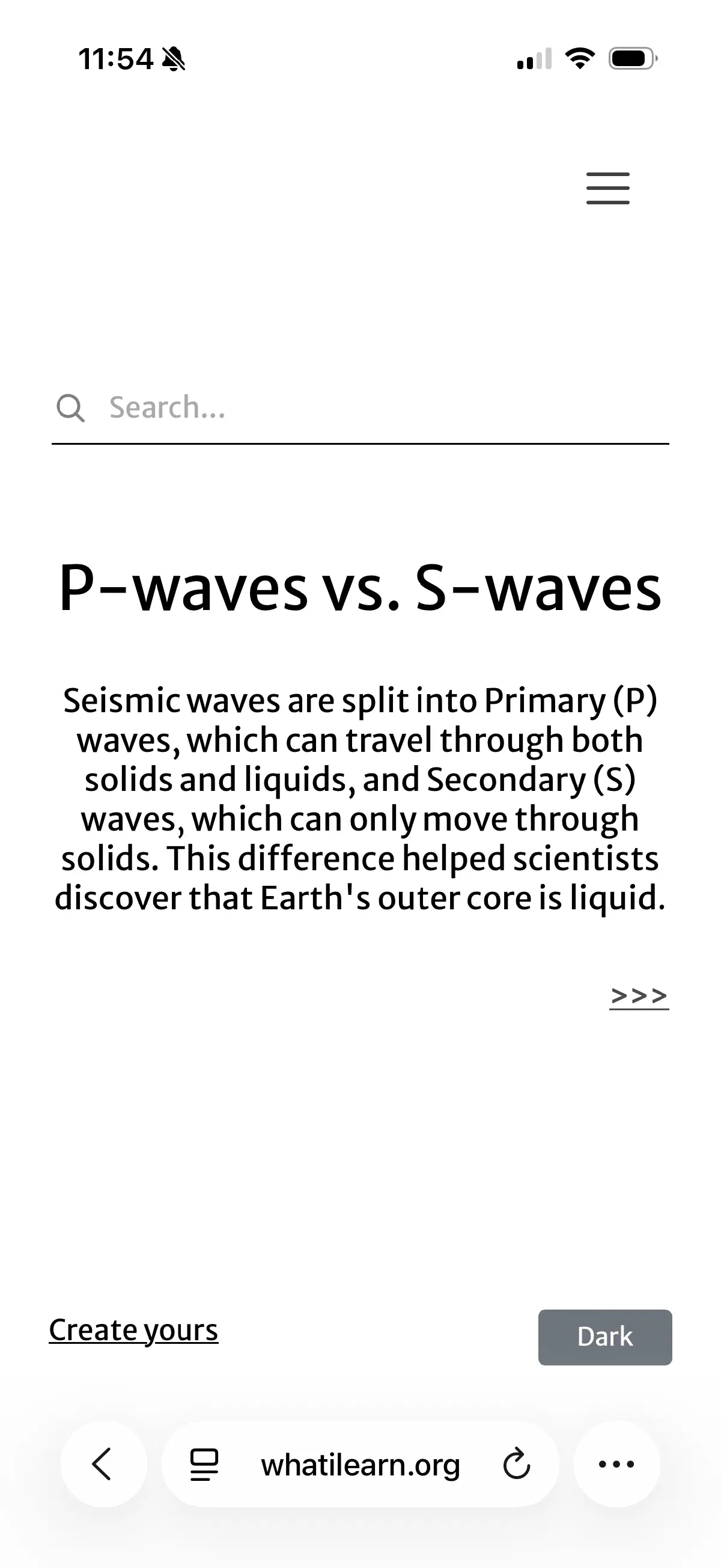
Thus, whenever I want to learn something — anything really — I simply navigate to the site, or refresh the page, and it prompts new knowledge to me. At random, just like the world is.
There are no external links. No bells, nor whistles. No distractions. It’s just learning, in its purest form.
Very often I want to add a new brick to my knowledge. Yesterday, for instance, I learned that the “Journey to the center of the Earth” ends in Italy. In the same book I found a great quote by Virgil, which I also thought worth adding to my personal library of bricks of knowledge. Random stuff. So the site has a “sign-in” feature, and the bricks added by a signed-in visitor are private to that visitor. Even though I think all knowledge should be public, I realized that if I made all bricks public then I’d have to make sure visitors don’t add incorrect information; to solve this problem efficiently — because, you know, I don’t like to chase trolls on the Internet — I decided to make each brick private to the same user who created it. The only public bricks are the ones my brother and I make.
The site is disturbingly simple. A user cannot do much: Browse public bricks of knowledge; add new ones (private); browse their own private ones. And that’s it.
Bricks are shown randomly. The site is designed to fit small, mobile phones screens. There isn’t a document graph. (I don’t know why people making note takers are obsessed with document graphs. I find them useless) There isn’t a keyboard shortcut to insert images. Nor to embed videos. It’s just text, and it has to be brief and compelling. I put the limit at 600 characters for every new brick. Every time I add a new brick, I am surprised at how a concept can be communicated clearly in 600 characters. It just takes some effort in the writing, but it’s precisely that effort that makes the knowledge stick long-term.
Maybe we are just used to companies out there prompting us too much information, in the attempt to guide, forcefully, our thoughts in the direction they want. What about getting unused to it? What about a blank page, for a change?
As simple as it looks, and even though I keep tinkering about how we, people, learn, I cannot but ask: is anything else needed, really?